
Global Genre Patterns
The map above shows the most popular film genre per country over time. From this map, it is interesting to see that “Comedy” is one of the most popular genres worldwide. This observation is consistent with the fact that comedy has long been a way to deal with tough situations and conflict, as the genre makes it easy to convey difficult messages in an easy-to-digest way. Additionally, in the Middle East, darker themes such as “War” and “Crime” take precedence, directly relating to ongoing political conflicts in this region, while “Action” and “Crime” are prominent in South America: regions with instability and crime. While boxing countries in a single genre is not a fool-proof way to understand films’ relationships with society, it does reveal that genres are a generally good way to represent the social climate in a country, whether that be by highlighting discord through darker themes or shifting public opinion with light-hearted, comedic genres.
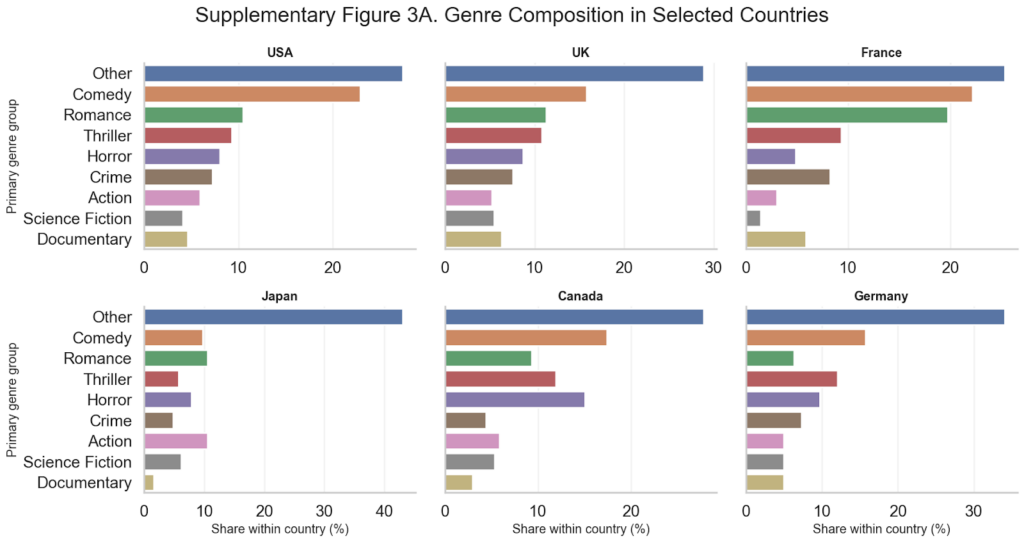
The chart above compares genre composition across 6 countries and shows that while some patterns are shared, each national film landscape still has a distinct shape. In all 6 cases, the largest category is “Other”, which suggests that film production in each country is spread across many genres, rather than being dominated by only one or two major types. At the same time, the smaller genre categories still show meaningful differences, which helps us see how national film cultures are not all the same.
Among the six countries, the United States and the United Kingdom both show strong shares of comedy, which may reflect the popularity of lighter and more commercially accessible storytelling in English-language markets. France also has a high share of comedy, but what stands out more is its especially large romance category. Compared with the other countries, France seems to place more emphasis on romantic storytelling, which may point to different audience tastes or longer cultural traditions around emotionally driven films. Germany shows a different pattern, with relatively stronger thriller and crime shares, suggesting a somewhat darker or more serious genre profile. Canada is also interesting because horror takes up a noticeably larger portion there than in several of the other countries.
Japan looks the most different from the rest. Its “Other” category is much larger than in the other five countries, while the remaining genres are all relatively small. This may mean that Japanese films are distributed across a wider range of genre labels that are not captured by the main categories shown here. It could also suggest that Japan’s film market has a more distinct genre structure that does not align as closely with the dominant genre groupings seen in North American and European contexts. In other words, even though all six countries participate in global film culture, they do not organize or produce films in the same way.
This matters for our project because it supports the idea that genre is connected to cultural and national context. Genres are not just neutral labels used to sort films. They can also reflect what different audiences enjoy, what film industries choose to produce, and what kinds of stories become culturally important in different places. For example, a higher share of romance in France or a higher share of horror in Canada may point to differences in viewing preferences, industry history, or social mood. Overall, this figure shows that genre composition varies across countries in ways that are socially and culturally meaningful, which helps us connect film data to broader patterns of cultural difference.
Film Market Investment and Revenue


The first map represents the average gross income a film generates from box office sales, and the second map indicates the average cost required to produce a film. Both maps present a compelling visual representation of the financial dynamics within the film industry. First, we can see the significant disparity between investment and return. As we can see from the legend, the highest average film budget sits at $41.3 million, while the highest film revenue is rounded to $176 million. This return ratio and substantial investment also account for the relatively conservative narrative often found in mainstream films, as studios tend to minimize risk when committing such large sums of capital. This phenomenon can be seen in the films regarding the 2008 Financial Crisis. For instance, Up in the Air, The Company Men, and Wall Street: Money Never Sleeps all decentralize and neglect the serious consequences of governmental and collective political decisions and pivot to focus on the dramatic fall of greedy individuals. (Kinkle and Toscano 40) The tendency to make the realistic issue entertaining has illustrated the cautious narrative prevailing in the film industry nowadays.
From the color density, we see the major film markets: China, Europe, and the United States get the largest average investment; China and Hollywood also generate the highest income, yet the European market gains relatively small compared to its spending. This reflects the high correlation between the market size and the studio investment (risk evaluation), while highlighting the impact of high government subsidies and local film market protections in Europe, which can sustain production despite lower financial returns. Considering the above “Most Popular Film Genre by Country” map, we observe that the European film market has the most integrated audience preference, such as Crime, Family, Thriller, etc. This observation reinforces our findings that the socio-economic context factually influences the film genre preference of different countries and the development of studio filming plans.
At the bottom of the map, we notice an “outlier”: New Zealand. Compared to the large markets such as the US and China, New Zealand is far smaller. Looking into our data, we found the most lucrative films associated with New Zealand were The Lord of the Rings and The Hobbit series, which were co-productions between the US and New Zealand. Beyond the two tentpole series, New Zealand also collaborated with Hollywood to produce the monster series films, such as King Kong. These films all featured magnificent landscapes and the extensive use of special effects, leveraging New Zealand’s unique natural scenery and advanced filmmaking infrastructure. This phenomenon again illustrates how the large market demand for tentpole films has radiated outward, reaching small countries such as New Zealand and therefore creating the globalized film market through co-production. This example demonstrates how societal market needs, such as the audience’s appetite for grand-scale entertainment, actively boost the production end of the industry, enabling small nations to become integral players in the global cinematic landscape.